Selecting the right aluminium melting furnace in 2026 requires more than comparing purchase prices. Furnace performance depends on alloy range, batch size, production rhythm, energy availability, and workplace conditions. No single design wins everywhere.
This article examines the leading furnace types used in modern aluminium foundries. It covers gas-fired reverberatory furnaces, electric resistance furnaces, induction furnaces, rotary furnaces, and crucible furnaces. Each option creates different trade-offs. Reverberatory models suit large batches and continuous production. Electric systems offer clean operation and precise temperature control. Induction furnaces can deliver rapid melting with strong process control. Rotary furnaces may support efficient recovery of aluminium scrap. Crucible furnaces remain practical for smaller workshops and flexible production.
The best choice also depends on metal quality requirements. Excessive holding time can increase oxidation and dross formation. Poor temperature control may affect casting consistency. These details matter on the shop floor, where operators monitor burner flames, power readings, crucible walls, and molten metal surfaces. Small visual changes can signal larger maintenance problems.
Reliable recommendations should combine engineering experience, manufacturer specifications, energy studies, and actual site conditions. Buyers should verify thermal efficiency, refractory life, emission controls, charging methods, safety systems, and service support. Some comparisons remain imperfect because published efficiency figures use different testing methods. That limitation deserves attention.
The following outline compares each furnace type by operating principle, advantages, limitations, suitable applications, and expected 2026 development trends.
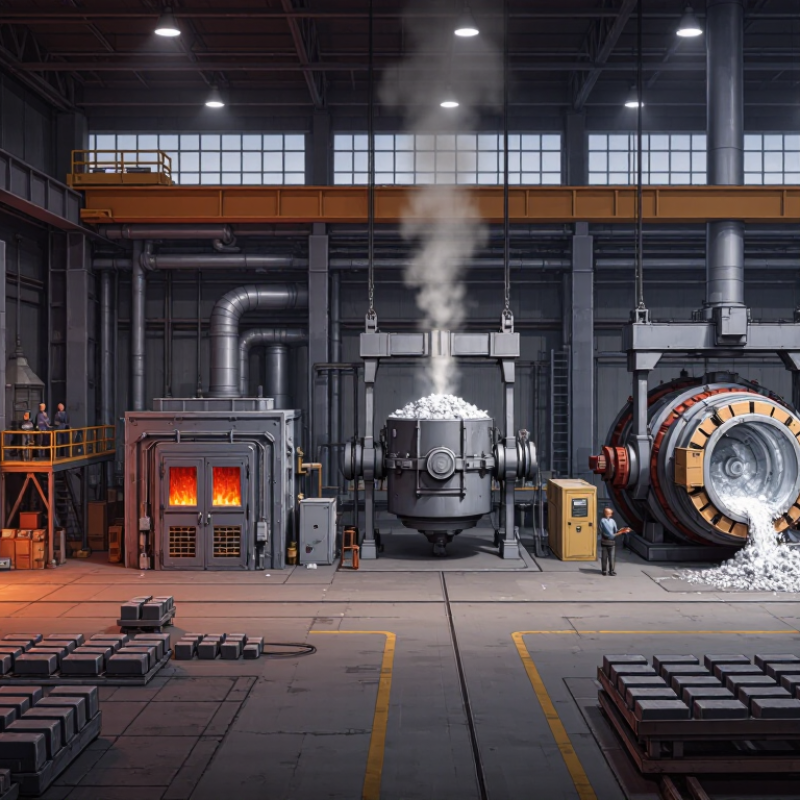
A modern aluminium melting furnace in 2026 is defined by measurable control, not appearance. The furnace must melt mixed scrap consistently, limit oxidation, and record energy use for every batch. The International Aluminium Institute reports that recycled aluminium requires about 95% less energy than primary production. That advantage disappears when poor sorting, excessive dross, or unstable temperatures reduce metal yield.
Energy data also changes furnace selection. The U.S. Department of Energy’s Industrial Decarbonization Roadmap identifies process heating as roughly half of industrial energy demand. Modern reverberatory furnaces therefore use regenerative or recuperative burners, improved insulation, and heat recovery. Electric induction furnaces offer precise control and low local emissions, but their value depends on electricity sources, charge size, and alloy requirements. Rotary furnaces remain useful for contaminated scrap, although salt use and residue management need careful evaluation.
Sensors matter more than brochures. Temperature probes, oxygen monitoring, and exhaust analysis can reveal a cold corner or an over-fired burner before quality declines. Digital records also support traceability and maintenance planning. Yet automation is not magic. A sensor may drift. Operators still need practical experience beside the furnace. The best design balances melt rate, recovery, emissions, safety, and repair access. It should also tolerate real scrap, not only laboratory-grade feedstock. That distinction is often missed.
In 2026, furnace selection depends on alloy, batch size, energy source, and emission controls. The choice matters. The USGS Mineral Commodity Summaries 2025 reported approximately 72 million metric tons of primary aluminium production worldwide in 2024. Meanwhile, the International Aluminium Institute reports that recycled aluminium can require up to 95% less energy than primary production. These figures strengthen the case for efficient remelting systems and accurate process control.
Reverberatory furnaces use burners to heat a chamber, while reflected heat melts aluminium on the hearth. They suit high-volume operations and continuous charging. However, poor flame adjustment may increase oxidation and metal loss.
Crucible furnaces heat a contained metal bath directly or indirectly. They offer simple operation and flexible batch production, especially for smaller foundries.
Induction furnaces use electromagnetic fields to generate heat inside the charge. They provide rapid melting, clean temperature control, and reduced direct combustion.
Electric resistance furnaces heat elements surrounding the chamber. They can deliver stable temperatures for holding and controlled melting.
Rotary or tilting furnaces improve contact between heated surfaces and irregular scrap. They also support faster discharge and easier slag separation.
The numbers can mislead. Actual performance depends on charge cleanliness, door-opening frequency, insulation, and operator timing. A technically advanced furnace still wastes energy when wet scrap enters the chamber.
Experienced teams should compare melting rate, recovery percentage, electricity or fuel consumption, and maintenance records before selecting equipment.
In 2026, reverberatory, rotary, electric resistance, and induction furnaces remain leading choices. Reverberatory furnaces suit high-volume production and large charge sizes. Their open bath supports steady output, but heat losses can be significant. Rotary furnaces handle contaminated scrap well, although salt use and maintenance require careful control. Electric resistance furnaces provide clean, stable heating with accurate temperature settings. Induction furnaces deliver rapid melting and strong mixing, but their capacity may be limited for very large batches. No furnace wins everywhere.
Energy data needs careful interpretation. The International Aluminium Institute reports that recycled aluminium requires roughly 5% of the energy used for primary aluminium production. This advantage depends on efficient remelting equipment and prepared scrap. The European Aluminium Environmental Profile Report also highlights melting efficiency as a major factor in recycled aluminium’s footprint. In plant audits, operators often compare kWh per tonne, melt loss, holding time, and recovery rate. Temperature control matters just as much. A stable bath near the required alloy range can reduce oxidation and unnecessary reheating. A neat spreadsheet can still mislead when scrap moisture, door openings, or idle hours are ignored.
What Are the 2026 Top Types of Aluminium Melting Furnaces?
The best furnace depends on feedstock, batch size, alloy control, and energy targets. The International Aluminium Institute reported global primary aluminium production above 72 million tonnes in 2024. That scale keeps high-capacity reverberatory furnaces important for foundries and remelting plants. They suit continuous charging, large holding volumes, and stable casting lines. However, poor door management can increase heat loss and oxidation.
Induction furnaces offer cleaner, faster melting for workshops and medium-volume operations. Their electromagnetic stirring improves temperature uniformity, especially when producing tight alloy specifications. Crucible furnaces remain practical for small batches, laboratory work, and frequent alloy changes. They require less installation space. Rotary furnaces are more suitable for heavily contaminated scrap, including painted or mixed aluminium feedstock. Their rotating action supports better metal recovery, but flux use and dross handling need careful control.
Energy efficiency is becoming harder to ignore. The U.S. Department of Energy states that recycled aluminium requires about 95% less energy than primary production. This supports efficient scrap-melting systems, although actual savings depend on sorting and furnace operation. In my experience, operators often overestimate furnace capacity and underestimate charging delays. A smaller furnace with reliable temperature control can outperform a larger unit. That choice is not obvious.
What Are the 2026 Top Types of Aluminium Melting Furnaces?
In 2026, aluminium foundries commonly compare reverberatory, crucible, induction, and electric resistance furnaces. Each design suits a different production pattern. Reverberatory furnaces support large batches and continuous casting lines. They use a broad chamber, allowing easier charging and alloy mixing. Crucible furnaces fit smaller operations with frequent alloy changes. They are compact, but manual handling can reduce consistency. Induction furnaces offer fast heating and accurate temperature control. However, they require suitable electrical capacity and trained maintenance staff. Electric resistance furnaces can provide clean, stable heating for controlled environments.
Selecting the right aluminium melting furnace starts with the metal, not the catalogue. Define your hourly output, batch size, alloy range, and charging method. A furnace for clean ingots may perform poorly with oily returns or oversized scrap. Check the working temperature, holding time, and expected metal loss. Aluminium oxidizes easily, so excessive turbulence can increase dross and reduce usable yield. Small details matter.
Energy cost also deserves careful measurement. Compare fuel or electricity use per tonne, not only the purchase price. Review insulation quality, burner or coil control, temperature sensors, access doors, and maintenance space. Emission controls may also affect installation planning and operating requirements. A larger furnace is not automatically better. It may consume more energy during idle periods. In practical evaluations, the most attractive design sometimes fails because operators cannot load it safely or clean it efficiently. Leave room for honest correction. Pilot testing with your actual charge materials is often wiser than relying on rated capacity alone.
| Furnace Type | Typical Batch or Holding Capacity | Primary Heat Source | Typical Aluminium Operating Temperature | Best-Suited Applications | Main Advantages | Key Limitations | Important Selection Factors |
|---|---|---|---|---|---|---|---|
| Crucible Furnace | Approximately 25–1,000 kg per batch, depending on crucible size and furnace design | Natural gas, LPG, diesel, or electric resistance heating | Usually about 700–800°C; aluminium melts at approximately 660.3°C | Small foundries, maintenance shops, laboratories, prototypes, and intermittent production | Relatively simple construction, low initial investment, flexible batch operation, and easy alloy changeover | Lower productivity for continuous operation; direct flame exposure may increase oxidation and metal loss; crucibles require inspection and replacement | Choose according to batch size, alloy-change frequency, fuel availability, crucible material, loading method, and required temperature control |
| Reverberatory Furnace | Commonly about 1–30 tonnes, with larger custom systems available | Gas or liquid fuel burners; electric versions are also possible | Generally about 700–850°C in the melting and holding zones | High-volume foundries, die casting, gravity casting, and continuous or semi-continuous production | Large capacity, high melting rate, compatibility with automatic charging, and separation of combustion gases from the metal bath | Large footprint, higher heat-up time, potential oxidation and dross formation, and greater need for burner and refractory maintenance | Evaluate required tonnes per hour, charging system, holding-zone control, flue-gas treatment, refractory life, and expected metal recovery |
| Rotary Furnace | Typically about 1–15 tonnes per batch, depending on shell volume and charge density | Gas or oxygen-enriched gas burners, with the furnace rotating around its axis | Usually controlled around 700–850°C for melting and treatment | Recycling contaminated aluminium scrap, chips, painted scrap, turnings, and dross-bearing materials | Strong material agitation, good contact between heat and charge, and suitability for difficult or low-density scrap streams | More mechanical complexity, possible oxidation during agitation, variable recovery depending on scrap contamination, and higher maintenance requirements | Prioritize scrap composition, oil and coating content, salt or flux practice, fume extraction, lining design, and metal-recovery targets |
| Induction Furnace | Approximately 100 kg to several tonnes per batch, depending on power rating and frequency | Electromagnetic induction supplied by an electrical power converter | Normally operated around 700–800°C for aluminium melting and holding | Clean scrap and ingot melting, controlled alloy production, laboratories, and operations requiring rapid heat-up and precise control | No combustion gases in the furnace, fast heating, strong electromagnetic stirring, compact layout, and accurate power control | High electrical infrastructure demand, sensitivity to charge composition and bath conditions, and potentially higher equipment cost | Check available electrical capacity, power quality, coil and lining design, stirring intensity, batch size, alloy cleanliness, and cooling-water requirements |
| Electric Resistance Furnace | Approximately 50 kg to 3 tonnes per batch; larger systems can be engineered for specific processes | Electric resistance elements, commonly positioned around the chamber or crucible | Typically about 700–850°C with programmable temperature control | Small-to-medium foundries, holding furnaces, heat-sensitive alloys, educational facilities, and low-emission indoor operations | Clean operation, quiet heating, good temperature uniformity, straightforward automation, and no direct combustion products | Heating can be slower than induction for some loads; electrical operating cost depends on local tariffs; elements and insulation require maintenance | Compare electricity price, required heat-up time, insulation quality, element replacement cost, atmosphere control, and holding-time requirements |
| Gas-Fired Holding Furnace | Approximately 200 kg to 10 tonnes of molten aluminium, commonly used after a separate melting stage | Gas burner with a controlled combustion chamber or immersion-style heating arrangement | Usually maintained around 680–760°C to limit unnecessary superheat | Die-casting cells and casting lines requiring stable metal availability and temperature between batches | Supports continuous casting supply, reduces temperature fluctuations, and can be integrated with automatic pouring or transfer systems | Not normally the most efficient choice for melting cold scrap; combustion emissions and heat losses require proper ventilation and control | Assess holding time, transfer distance, temperature-loss rate, burner turndown, automatic level control, and integration with the casting machine |
Fill out the form below and our team will get back to you ASAP.
Snake Tray® is Green and Proudly Powered by the Sun! Snake Tray is committed to designing and manufacturing products that have many green benefits. Our products are made of recycled goods, minimize material waste, are energy efficient, use less non-renewable resources and nest together read more…
Snake Tray® 291 Skip Lane, Bay Shore NY 11706 | PHONE: 631-674-0004 | FAX: 631-674-0010 | www.bakoselectric.com | LEGAL | MADE IN USA
© 2025 SnakeTray. All rights reserved
Fill out the form below to download your document.