China Best Isolation Mounts for Global Buyers? The question deserves more than a supplier list. Isolation Mounts support engines, pumps, generators, laboratory equipment, and industrial cabinets where vibration can damage components or disturb measurements. A poor mount may look acceptable during installation, then transmit noise through a steel frame after months of operation.
Industry reports show why this category is gaining attention. MarketsandMarkets’ Automotive NVH Materials Market analysis identifies vibration and noise reduction as continuing priorities across vehicle development. Grand View Research also reports steady growth in global vibration control applications, supported by manufacturing, transportation, and energy projects. These reports do not evaluate every Chinese factory, however. That limitation matters.
Reliable sourcing requires measurable evidence. ISO 10846 standards provide methods for determining transfer stiffness in resilient elements. Buyers should request load ratings, static deflection data, operating-temperature ranges, rubber compound details, and test conditions. A mount designed for a 500-kilogram pump cannot automatically serve a high-speed compressor. The drawing may fit. The performance may not.
China offers broad manufacturing capacity, competitive tooling, and flexible production for customized Isolation Mounts. Experienced buyers should still verify material traceability, batch consistency, corrosion protection, and quality-control records. Factory audits help, but they are not perfect. Samples can outperform routine production.
This guide examines supplier capability, design selection, testing, export readiness, and total ownership cost. It focuses on practical decisions, not promotional claims. Global buyers need evidence they can compare, reproduce, and question before approving a purchase.
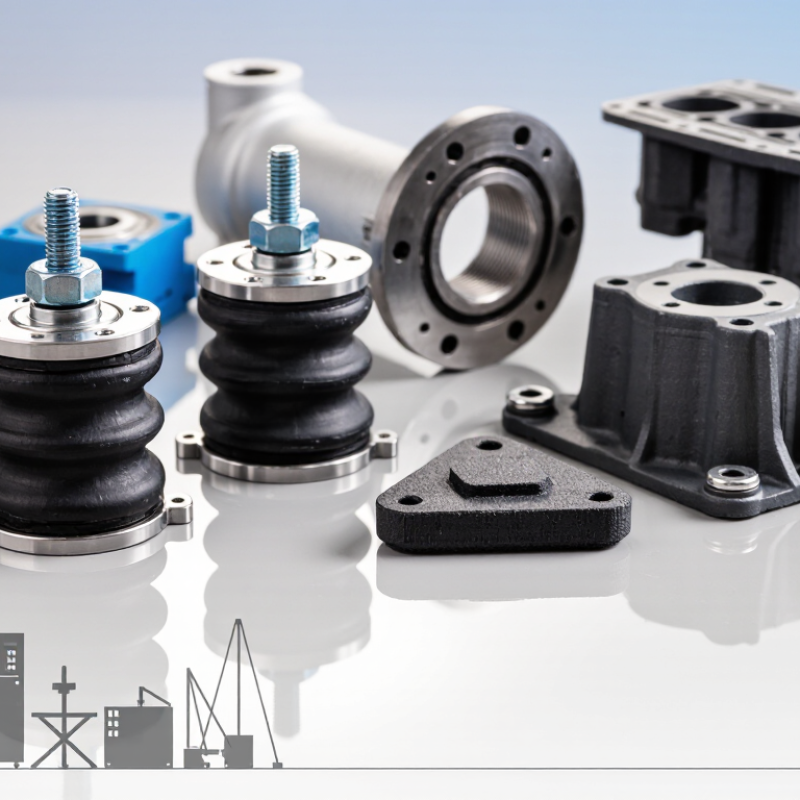
What Are Isolation Mounts and How Do They Work?
For global buyers evaluating isolation mounts from China, the basic question is practical: what vibration must be controlled? An isolation mount sits between a machine and its support. It uses elastomer, steel springs, wire rope, or air pressure to reduce transmitted vibration. The principle is simple. The mount lowers the system’s natural frequency, then limits energy passing into the floor, frame, or nearby equipment.
A spring’s stiffness and the supported mass determine natural frequency: fn = 1/(2π)√(k/m). Effective isolation usually begins above approximately 1.4 times that frequency, although damping changes the result. A mount that is too stiff may transfer vibration efficiently. A mount that is too soft may allow excessive movement during startup. In field inspections, uneven loading is a common problem. One corner can compress more than the others, creating noise, misalignment, and premature fatigue.
The European Environment Agency reported that more than 113 million people in Europe were exposed to harmful long-term road traffic noise above 55 dB Lden in its Environmental Noise in Europe 2020 report. Isolation mounts cannot solve outdoor noise alone, but they can reduce structure-borne vibration inside buildings. Buyers should check static load, dynamic load, deflection, temperature range, corrosion resistance, and tested stiffness data. ISO 10816 and ISO 20816 provide useful vibration-evaluation frameworks, but they do not replace application-specific testing. A catalog rating is only a starting point. Real machines behave differently.
China supplies a wide range of isolation mounts for industrial, transport, construction, and laboratory equipment. The commonest type is the rubber mount, valued for simple installation, low cost, and noise reduction. It suits pumps, motors, compressors, and small generators. Rubber hardness must match the equipment’s weight and operating frequency.
Spring mounts provide greater deflection and better low-frequency isolation. They are often used beneath chillers, fans, and heavy mechanical units. Wire rope mounts resist corrosion and tolerate shock, making them useful in marine, outdoor, and mobile applications. Air mounts offer adjustable support for precision equipment, although they require clean air and careful pressure control. A poor pressure setting can create instability.
China-based manufacturers also produce neoprene pads, rubber-metal bushings, and restrained mounts for equipment exposed to movement. Neoprene pads work well under compact machinery, while restrained mounts help control lateral motion during starts and stops. During sourcing, buyers should request load tables, stiffness data, temperature ranges, and fatigue-test records. Sample testing matters more than attractive photographs. We have seen mounts selected only by load rating, then fail because the actual vibration frequency was ignored. Check bolt dimensions, deflection, rubber compound, and installation drawings before approving production. Supplier experience is useful, but measurable test evidence remains more reliable.
How to Evaluate Chinese Isolation Mount Manufacturers
Selecting Chinese isolation mount manufacturers requires more than comparing prices. Ask for material specifications, load ratings, temperature ranges, and tested vibration performance. A reliable supplier should explain how each figure was measured. Request production drawings, inspection records, and sample reports before approving bulk orders. Technical answers should be clear, not vague.
A factory visit can reveal important details. Check rubber or elastomer storage, mold cleanliness, curing equipment, and final inspection stations. Ask operators how they control hardness and bonding consistency. Review batch traceability from raw material receipt to packed units. Independent laboratory testing can confirm stiffness, compression set, and fatigue resistance. It costs more, but failed mounts cost more.
Pay attention to communication quality. Can the manufacturer discuss tolerances, installation conditions, and failure modes without avoiding difficult questions? Ask for samples from normal production, not specially prepared pieces. Compare dimensions with calibrated tools and inspect metal surfaces for uneven coating or sharp edges. A polished website proves little. In practical sourcing, small details often matter most.
Do not ignore weaknesses. Some factories may provide excellent samples but weaker process control during larger orders. I would include a pre-shipment inspection and a written change-control requirement. That approach is not perfect, and inspections can miss hidden defects. Still, it creates evidence for better decisions. Clear packaging labels, moisture protection, and consistent batch numbers also reduce trouble after arrival.
A practical, evidence-based evaluation framework for comparing Chinese isolation mount manufacturers without relying only on price. The benchmark values below are typical screening references and should be confirmed against the required application, drawing, material specification, and validation plan.
| Evaluation Dimension | What to Check | Typical Technical Benchmark | Acceptable Evidence from the Manufacturer | Suggested Weight | Score |
|---|---|---|---|---|---|
| Product Type and Design Fit | Whether the supplier can provide the correct mount architecture for the load, motion, temperature, and vibration profile. | Rubber-metal mounts, bonded bushings, spring mounts, wire-rope isolators, and custom assemblies should be selected according to static load, dynamic load, natural frequency, stroke, and installation direction. | Product drawings, load-deflection curves, dynamic stiffness data, CAD files, installation instructions, and design calculations. | 15% | __/10 |
| Load Capacity and Deflection | Accuracy of rated load, working load range, compression or shear deflection, and safety margin. | The working load should be specified by direction and operating condition. A documented design safety factor is preferable to using the catalog maximum as the continuous operating load. | Compression and shear test reports, load-deflection charts, finite-element analysis where relevant, and clearly defined static and dynamic ratings. | 12% | __/10 |
| Isolation Performance | Natural frequency, transmissibility, damping, resonance behavior, and performance across the operating frequency range. | For a passive isolator, effective isolation normally begins when the excitation frequency is sufficiently above the system natural frequency; the exact result depends on damping, preload, and the complete mounted system. | Dynamic stiffness or transmissibility curves, frequency-sweep data, test fixture description, preload conditions, and measurement uncertainty. | 15% | __/10 |
| Material Selection | Elastomer type, hardness, metal grade, corrosion protection, and compatibility with the operating environment. | Common elastomers include natural rubber, EPDM, neoprene, nitrile rubber, silicone, and fluorocarbon rubber. Selection should consider temperature, oil, ozone, UV, coolant, salt spray, and chemical exposure. | Material datasheets, compound identification, hardness specification, batch traceability, restricted-substance declarations, and compatibility test results. | 12% | __/10 |
| Temperature Capability | Continuous and intermittent temperature limits, thermal aging, and performance retention after exposure. | Typical elastomer temperature ranges vary substantially by compound. The supplier should state both continuous-use and short-term limits instead of quoting one generic temperature number. | Thermal aging reports, temperature-cycle test results, compound specification, post-aging hardness and tensile data, and application-specific validation. | 8% | __/10 |
| Mechanical and Environmental Durability | Fatigue life, creep, compression set, ozone resistance, corrosion resistance, and failure mode control. | Testing should reproduce the actual load direction, amplitude, frequency, temperature, and environmental exposure. A universal cycle-life claim without test conditions is not sufficient for comparison. | Fatigue test reports, compression-set results, ozone or weathering tests, salt-spray results for metal parts, and documented failure analysis. | 12% | __/10 |
| Dimensional and Process Control | Control of critical dimensions, bonding quality, rubber hardness, concentricity, surface finish, and batch consistency. | Critical tolerances should be defined on the drawing and verified with calibrated inspection equipment. Rubber-to-metal bonding should be controlled through surface preparation, adhesive process, cure conditions, and visual inspection. | Control plans, process flow charts, inspection records, capability studies, calibration certificates, and sample parts from more than one production batch. | 10% | __/10 |
| Quality Management | Formal quality system, document control, corrective action, nonconformance handling, and traceability. | ISO 9001 certification is a useful baseline. Automotive applications may additionally require IATF 16949, while environmental management can be supported by ISO 14001. | Current certificates issued by an accredited certification body, audit scope, process audit results, corrective-action records, and lot-level traceability examples. | 8% | __/10 |
| Compliance and Export Readiness | Ability to meet destination-market substance restrictions, packaging rules, labeling, and technical-documentation requirements. | For many global markets, buyers may request RoHS and REACH declarations. The applicable requirements depend on the product, destination, industry, and customer specification. | Supplier declarations, laboratory test reports where required, safety data information, packaging specifications, country-of-origin documents, and export references with sensitive information removed. | 6% | __/10 |
| Testing Capability | In-house and independent laboratory capacity for static, dynamic, environmental, dimensional, and material testing. | A capable supplier should be able to define test method, sample size, conditioning, acceptance criteria, and equipment calibration status for each validation activity. | Equipment list, calibration records, test-method references such as ISO or ASTM standards, raw data samples, and third-party laboratory reports when applicable. | 5% | __/10 |
| Tooling and Customization | Engineering support, mold design, prototype speed, change control, and ownership of customer-specific tooling. | A clear development process should cover design review, prototype approval, production-part approval, engineering-change notification, and retention of tooling records. | Development schedule, prototype samples, drawing-revision control, tooling agreement, sample approval process, and documented engineering-change procedure. | 5% | __/10 |
| Supply Reliability and Commercial Risk | Production capacity, lead time, minimum order quantity, continuity planning, packaging, logistics, and communication quality. | Lead time should be separated into tooling, prototype, first production, and repeat-order stages. Supplier claims should be checked against capacity evidence and recent delivery performance. | Capacity statement, production schedule, business-continuity plan, packaging validation, shipment records with confidential details removed, and written escalation contacts. | 7% | __/10 |
Recommended decision rule: Request technical documentation and representative samples from at least three qualified suppliers. Do not approve a manufacturer based solely on unit price, catalog load rating, or a certificate. Confirm performance through application-specific testing, including load-deflection, dynamic isolation, environmental aging, fatigue, dimensional inspection, and final assembly validation.
China Best Isolation Mounts for Global Buyers?
Material choice decides whether an isolation mount survives real machinery. Natural rubber offers strong damping and low cost. Neoprene handles oils, weather, and moderate heat better. Silicone tolerates wider temperatures, but it often carries lower loads. Stainless steel inserts resist corrosion in humid plants. However, a higher hardness rating does not guarantee better isolation. Buyers should request load-deflection curves, compression-set results, and temperature data. ASTM D395 and ISO 815 provide recognized methods for evaluating elastomer compression behavior.
Performance must match the machine, not only the catalog. A mount supporting 500 kilograms needs measured static deflection, lateral stability, and fatigue results. ISO 10816 and ISO 20816 describe vibration evaluation practices for rotating machinery. These standards help buyers compare test conditions. A 2023 industrial vibration-control market report estimated continued growth through the decade, driven by factory automation and equipment reliability demands. The figure is useful, but market forecasts are not engineering proof.
Certification needs careful checking. ISO 9001 supports controlled production, while material declarations may address RoHS or REACH requirements where applicable. CE marking is not automatically required for every passive mount. The complete machine may carry that obligation. Ask for batch traceability, third-party test reports, and actual working-temperature limits. I would reject vague claims such as “military grade.” They sound impressive. They prove little. Suppliers should also disclose aging tests, because rubber can harden, crack, or creep after installation. A missing test condition remains a real weakness.
China Best Isolation Mounts for Global Buyers?
How Global Buyers Can Manage Sourcing and Quality Control
Selecting isolation mounts from China requires more than comparing unit prices. Buyers should define load capacity, compression range, temperature exposure, frequency response, and required service life before requesting quotations. A clear technical drawing prevents costly interpretation errors. It also gives suppliers measurable targets.
McKinsey Global Institute reported that severe supply chain disruptions can occur about every 3.7 years, with major financial effects. Dual sourcing may reduce exposure, but it can also create inconsistent rubber compounds, metal hardness, or mounting dimensions. Buyers should approve one controlled specification, then audit both suppliers against it. Request material certificates, batch records, dimensional reports, and test results for each production lot. A pre-shipment inspection should check hardness, bonding, surface defects, thread accuracy, and packaging protection. Small defects matter.
Quality control should continue after delivery. Keep retained samples from approved batches and compare them during incoming inspection. Use calibrated equipment, not visual judgment alone. For critical applications, require dynamic stiffness and fatigue testing under realistic temperature and load conditions. ISO 9001 certification can indicate a documented management system, but it does not guarantee every part is suitable. I have seen compliant paperwork hide weak sampling plans. That is why buyers should review test methods, acceptance limits, and corrective-action records directly. The best sourcing decision balances verified performance, traceability, communication speed, and total risk—not the lowest quotation.
Global Sourcing and Quality-Control Scorecard for Isolation Mount Suppliers
This illustrative 100-point procurement model prioritizes performance validation, material traceability, dimensional consistency, documentation, and delivery reliability. Buyers can use it to compare suppliers without relying on brand names alone.
Fill out the form below and our team will get back to you ASAP.
Snake Tray® is Green and Proudly Powered by the Sun! Snake Tray is committed to designing and manufacturing products that have many green benefits. Our products are made of recycled goods, minimize material waste, are energy efficient, use less non-renewable resources and nest together read more…
Snake Tray® 291 Skip Lane, Bay Shore NY 11706 | PHONE: 631-674-0004 | FAX: 631-674-0010 | www.bakoselectric.com | LEGAL | MADE IN USA
© 2025 SnakeTray. All rights reserved
Fill out the form below to download your document.